about
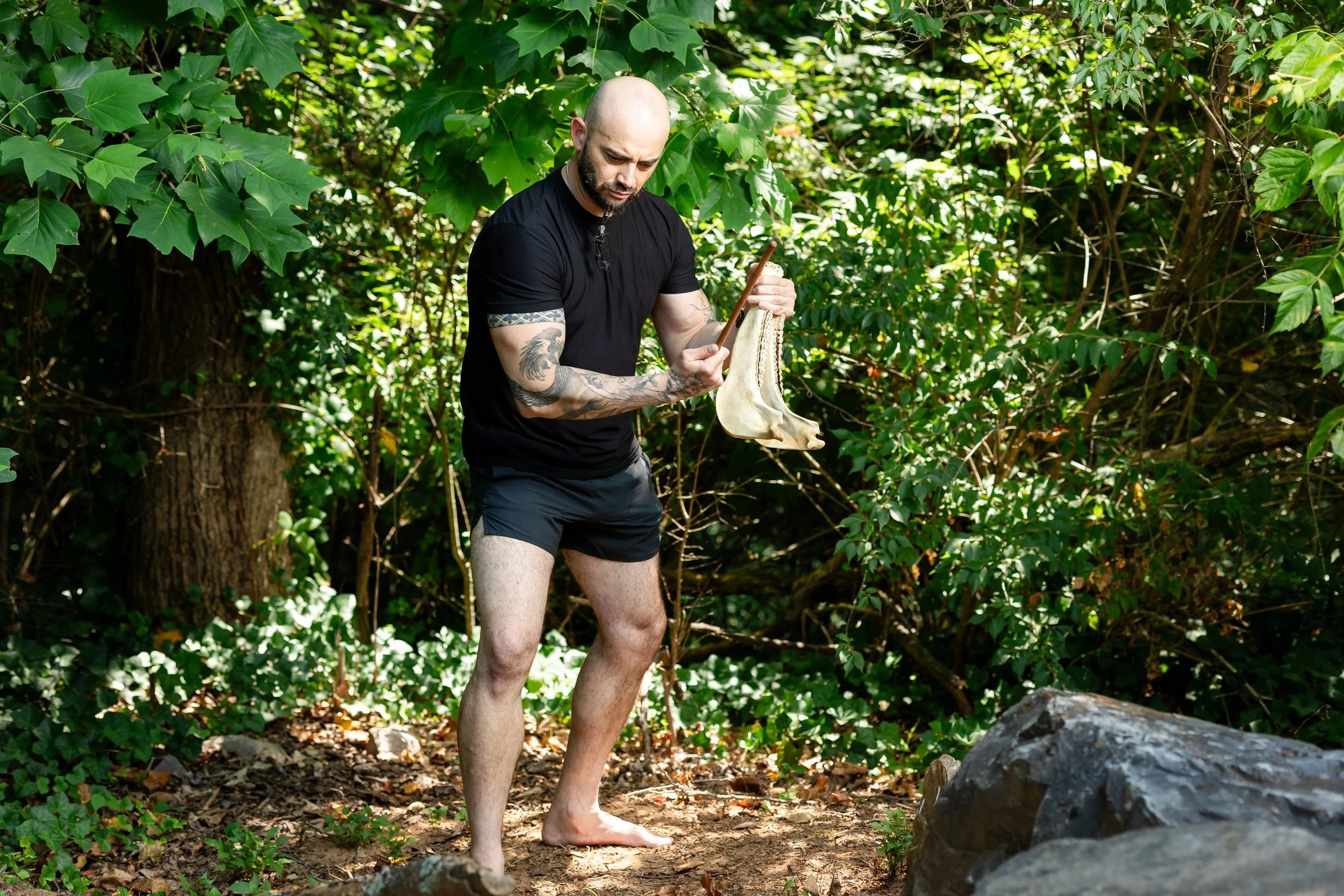
Image courtesy of Loghaven Residency.
My identity as a visually impaired, Costa Rican American, immigrant, and Miskito descendant infuses my work with a profound commitment to the political, social, and artistic dimensions of disability, migration, and Indigeneity.
This multidimensional perspective shapes my practice, driving me to explore the cultural reclamation through my art.
NO to Cultural Extractivism
My projects operate with the highest ethical standards. The ensemble works exclusively with artists who have been directly impacted by socio-political conflicts in Central and South America. This ensures that all participants are fairly compensated, properly credited, and that any exchange of knowledge or creative input is conducted in an environment of mutual consent, care, and respect.
Artist statement
My performances do not merely evoke—they invoke.
As an archaeological choreographer, I weave embodied history into presence, where every gesture becomes an archive and every movement a method of discovery.
I reimagine social interactions as sites of excavation—an interrogation of the present and a speculation on the future—delving into my Central American heritage. Platforms like eBay, Google Maps, and YouTube transform into tools for uncovering and reclaiming a forgotten past. Through the search and rescue of objects, books, DVDs, CDs, clothing, indigenous musical instruments, and postcards tied to my Miskito Indigenous ancestors, I reconstruct my own narrative. My performances unfold as vibrational acts of reconnection, weaving together ecological soundscapes, film, and installation into a living testament to heritage and belonging.
At the core of my practice is my methodology Vortex, an alchemy that transforms visuomotor concepts into sensory experiences. Through proprioceptive breathing and bioelectricity, Vortex triggers movement as a whirlwind of energy, a spiral of meaning, a way to find center in chaos.
Principles
My performances emerge as three interconnected principles:
1. Time
Performance unfold over hours, days, or weeks, transforming endurance into a radical act. Crip time, a rejection of ableist temporal norms, becomes a framework, where the body’s pace is a site of liberation.
Principles:
Temporal expansion as a critique of productivity and efficiency.
Repetition and accumulation to challenge perceptions of progress and exhaustion.
Relational structures that invite audiences to witness or co-create the experience.
2. Language
Language is a living score reimagining audio description as a standalone art form. Words and movement intertwine blurring the boundaries between poetry, instruction, access and embodied knowledge.
Principles:
Notation as a score, where text is not just spoken but performed, embodied, and subverted.
Polyphony and rhythm: Words are composed with cadence, silence, and breath, mirroring musical structures.
Deconstruction and reconstruction: Language is fragmented, reassembled, or invented to reclaim narratives in collaborative autorship.
3. Justice
My work is inherently political, a reclamation of what has been lost. It challenges dominant narratives of immigration, disability, and indigeneity.
Principles:
Disrupt ableist and colonial frameworks in art and movement.
Solidarity as a core aesthetic and ethical principle.
Reimagine sustainability ecologically, socially and artistically.